

 Search
Quick Answer: Women looking to excel at the shooting range should prioritize mastering fundamental techniques, developing a consistent practice routine, and working with qualified instructors who understand the unique considerations for female shooters. Regular firearm training with specific drills tailored to build confidence and accuracy makes all the difference.
More women are discovering the shooting sports each year, whether for personal defense, competition, or recreational enjoyment. While firearm handling and safety apply to everyone, proper training from a qualified instructor helps female shooters build confidence and improve accuracy more quickly.
Foundation Training: Core Techniques Every Woman Should Master
The Four Safety Fundamentals
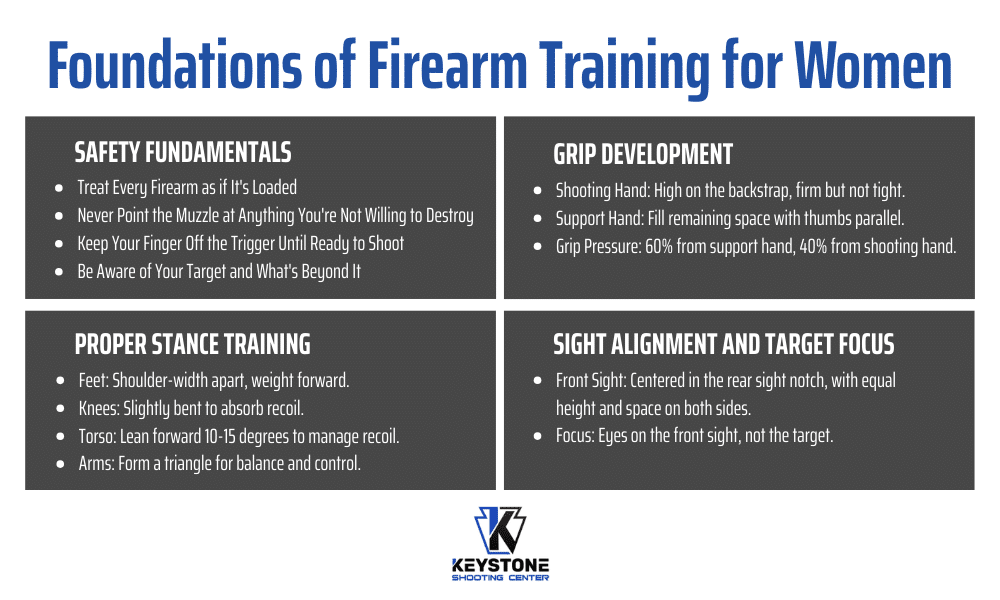
Safety is paramount for every shooter, and these four rules must be followed:
- Treat every firearm as if it’s loaded.
- Never point the muzzle at anything you’re not willing to destroy.
- Keep your finger off the trigger until ready to shoot.
- Always be aware of your target and what’s beyond it.
Proper Stance Training
The isosceles stance offers women a natural, balanced platform for defensive shooting. This stance gets its name from the triangle formed by your arms and chest, creating equal angles on both sides. Position your feet shoulder-width apart, with your weight evenly distributed, and knees slightly bent to absorb recoil. Lean forward from the waist about 10-15 degrees to counteract the backward push of recoil.
Women with different body types may need to adjust their foot positioning for comfort and stability. Taller shooters often benefit from a slightly wider stance, while shorter shooters maintain better control with feet closer together. The most common mistake beginners make is standing too upright, which makes managing recoil harder and reduces accuracy. Another frequent error is locking the knees, which creates tension and instability.
Grip Development for Accuracy
A high, firm grip gives you maximum control over the defensive pistol. Place your dominant hand as high on the backstrap as possible without interfering with the slide’s movement. Your support hand should fill the remaining space on the grip, with the thumb pointed forward along the frame. Both thumbs should rest on the same side of the handgun, parallel to each other.
Building grip strength improves your shooting skills and performance during range time. Simple exercises like squeezing a tennis ball, using hand grippers, or doing farmer’s carries develop the muscles needed for sustained shooting sessions. Grip consistency matters because any variation changes how the firearm recoils, affecting where your shots land. Test your grip by ensuring about 60% of pressure comes from your support hand and 40% from your shooting hand.
Sight Alignment and Target Focus
Understanding the relationship between your sights and target determines where your bullets hit. The front sight should sit centered in the rear sight notch with equal height and space on both sides. Your eye naturally wants to focus on the target, but training yourself to focus on the front sight produces better accuracy for self-defense.
For shooters with vision challenges, prescription shooting glasses or adjusted sight systems can help. Some women find red dot sights easier to use than traditional iron sights. The most important habit to develop is maintaining your sight picture through the entire shot, including trigger control and follow-through.
Essential Drills to Build Shooting Proficiency
Live Fire Accuracy Drills
Starting with accuracy drills, such as the wall drill and box drills, helps refine your sight alignment and trigger control. Distance progression training builds confidence by increasing the range as your accuracy improves.
Speed and Control Development
Once accuracy is consistent, begin practicing speed while maintaining precision. Push your speed until accuracy starts to drop, then dial it back to find the optimal balance.
Recoil Management Exercises
Managing recoil is key for new shooters. Begin with manageable calibers like .22 LR or 9mm to build confidence, then progress to more powerful options as your skills improve.
Malfunction Drills
Training to address malfunctions quickly ensures you’re prepared for real-world situations. Practice the “tap, rack, ready” procedure regularly until it becomes second nature.
Creating Your Personal Training Plan
Setting Realistic Goals
Start by honestly evaluating where you are right now. If you’re a beginner shooter new to shooting, your initial focus should be on gun safety, proper stance, and consistent trigger control. Record your current abilities by shooting a few groups at different distances and noting what feels comfortable versus challenging.
Short-term goal examples include keeping all rounds within an 8-inch circle at 7 yards, improving your reload speed by two seconds, or completing 50 dry fire repetitions three times weekly.
For long-term goal, you might aim to qualify for a concealed handgun permit, complete an advanced defensive pistol course, or participate in your first shooting sports competition.
Developing a Practice Schedule
Most shooters see the best improvement with one to two range visits per week. This frequency allows you to build muscle memory while giving your body time to rest between sessions.
Dry fire practice costs nothing and builds the fundamentals that translate directly to live fire. Spend 10 to 15 minutes working on sight alignment, trigger press, and drawing from a holster if you’re training for self-defense. This work prepares your brain and muscles for the shooting range.
Structure each training session with a clear purpose. Spend the first 10 minutes on fundamentals with slow, deliberate shots. Move into your main skill focus for 30 minutes, whether that’s working on speed, accuracy at distance, or malfunction drills. Finish with 10 minutes of relaxed shooting to end on a positive note.
Consistency matters more than marathon sessions. Regular practice reinforces good habits and prevents firearm skills from deteriorating. Two focused 45-minute sessions will produce better results than one exhausting three-hour marathon that leaves you tired and frustrated.
Working with Instructors
Professional firearm training accelerates your learning and prevents bad habits from taking root. An instructor can spot issues with your grip, stance, or trigger control that you might not notice on your own. They provide immediate feedback and customized solutions for your specific challenges.
Look for instructors with recognized credentials from organizations like the NRA, USCCA, or similar training groups. A female instructor with experience teaching women specifically can be valuable since some instructors better understand the unique considerations female shooters face, from clothing choices to handgun selection.
Private lessons offer personalized attention focused entirely on your needs. Group classes provide social learning, the chance to observe other shooters, and usually come at a lower cost per class. Beginner shooters often benefit from starting with a private session to build confidence before joining group settings.
Tracking Your Progress
Keep a shooting journal to track metrics such as group size and accuracy percentages. Recording results helps you see your improvement over time.
Common Training Challenges
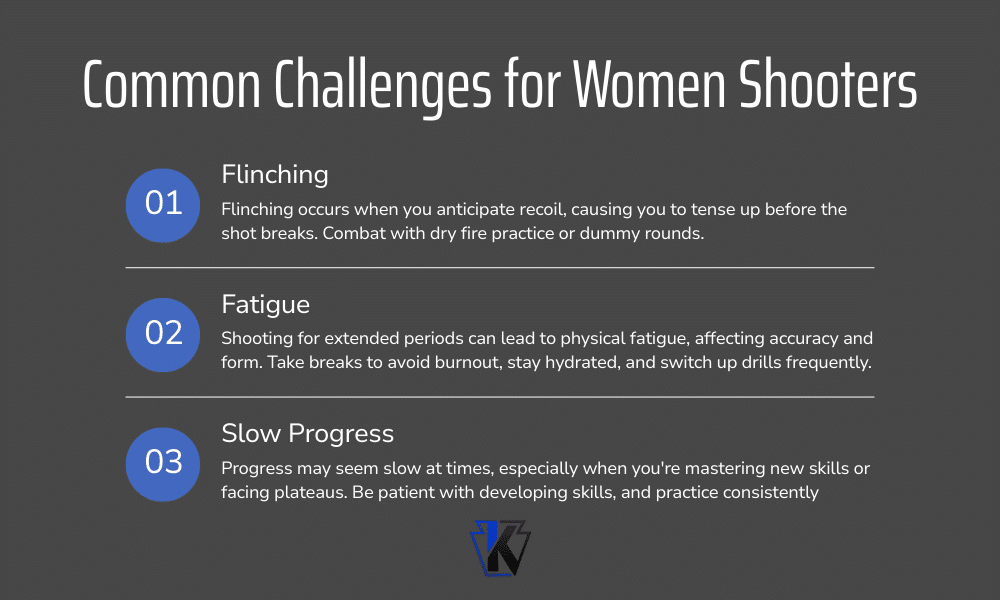
Flinching, fatigue, and slow progress are common hurdles. Combat this through dry fire practice and ball-and-dummy drills where someone else loads your magazine with random dummy rounds. When you flinch on a dummy round, you’ll immediately recognize the problem.
Building hand and arm strength improves control and reduces fatigue. Grip strengtheners, wrist curls, and even squeezing a tennis ball while watching TV translate to better handgun handling. When your arms shake or your groups open up significantly, stop shooting. Rest, hydrate, and either call it a day or switch to light dry fire work.
Slow progress frustrates everyone at some point. Remember that skill development isn’t linear. Some days you’ll shoot worse than the week before, and that’s normal. Focus on the process rather than demanding perfection from every session.
Join Women’s Shooting Groups
Find training partners or join shooting groups for women. Having people who understand your journey provides accountability, encouragement, and fresh perspectives. Many indoor shooting ranges host women’s nights or ladies’ leagues that create welcoming, comfortable environments for practice and learning.
Perfect Your Training With Keystone Shooting Center
Becoming a skilled shooter requires dedication to proper firearm training techniques and consistent practice. Focus on mastering the fundamentals including trigger control and gun safety, incorporate structured drills into your range time routine, and work with qualified instructors who can provide personalized feedback. Progress takes time, but with the right training approach and attention to firearm safety, any woman can develop confidence and accuracy at the shooting range.
At Keystone Shooting Center, we offer handgun classes and training programs specifically designed to help women develop their shooting skills in a comfortable environment. Our experienced instructors are NRA-certified and provide private instruction in a supportive environment. Whether you’re a beginner shooter new to firearms or an experienced shooter looking to advance your abilities in defensive shooting or personal defense, our classes and private lesson sessions cater to lady shooters of all skill levels.
Ready to take your shooting skills to the next level? Contact Keystone Shooting Center today to learn about our training class programs or schedule a private session with one of our expert instructors.